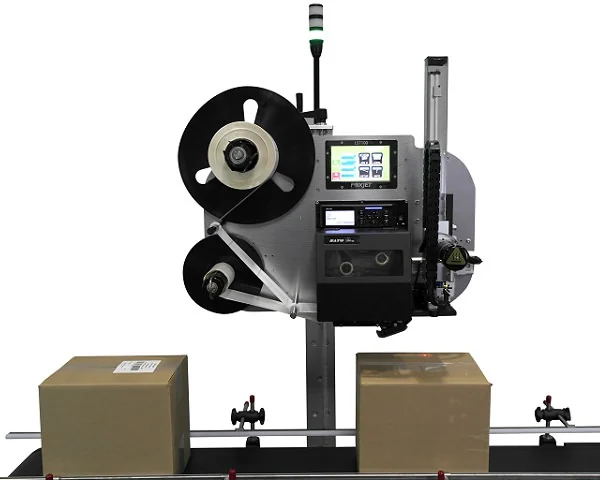
How to specify barcode verification for print and apply labelling
A scanner that reads one label is not the same as a controlled verification system. The project must define the data source, printed symbol, placement, verification method, failed-label response and evidence retained for acceptance.
What should a print-and-apply verification system prove?
A print-and-apply verification system should prove that the intended data was used, the label was printed, the required symbol is readable or verified to the agreed method, the label was applied to the correct product and any failure produced a defined stop or reject response. Each check must be named separately because one successful scan does not prove the whole chain.
The required evidence depends on the application. A warehouse may need a readable logistics label and transaction record, while a regulated or retailer-controlled process may require defined symbol verification, product tracking and a documented disposition for every failure.
Separate the data, print, application and verification stages
Map the process as four connected stages. First, the host, PLC, database or operator selects the data. Second, the print engine creates the label. Third, the applicator transfers it to the product, case or pallet. Fourth, inspection confirms the agreed result. A failure at one stage can look like a failure elsewhere: a correct barcode printed from the wrong record is still wrong, and a perfect label applied across a corner may still be unreadable.
Assign a unique product or job reference through the process where traceability is required. Define what happens when a product arrives without data, when the printer is not ready, when a label remains on the pad, or when the verifier cannot read the applied symbol.
Control the data source and job change
List every field that can change, its source and its format. Typical examples include product code, batch, date, quantity, destination, address, GTIN, SSCC or other logistics identifiers. Lancing cannot confirm the required system from a sample label alone; the data owner, update frequency and interface must also be known.
For recipe changes, decide how the operator confirms that the physical product and selected data match. Where an upstream system sends the job automatically, define message acknowledgement, timeout, duplicate-message handling and the action after communications are restored.
Distinguish readability from formal barcode verification
A normal barcode reader can confirm that it decoded a symbol under its own viewing conditions. Formal barcode verification uses a compliant verifier and reports measured symbol quality against the applicable specification. The acceptance requirement must therefore state whether the project needs simple presence/read checks, data comparison, formal verification, or a combination.
GS1 advises that final printed samples should be verified and that symbol quality depends on both printing and the material. The organisation also distinguishes visual checks, information checks and technical barcode verification. Useful primary references are the GS1 UK barcode review service and the GS1 explanation of barcode verification.
Print quality is affected by printhead condition, ribbon and label compatibility, speed, darkness settings, contamination, label movement and the design of quiet zones. A machine trial should use production-quality labels and the intended print consumables.
Protect barcode placement after the label leaves the printer
The barcode must remain readable after application. Avoid placing the symbol over seams, folds, tight curves, rough textures, damaged board or an edge that distorts the quiet zones. GS1 UK provides general barcode-placement guidance, but the final position must be checked against the actual pack and supply-chain requirement.
For pallets, confirm the required faces, height, edge clearance, label orientation and load condition. The existing pallet label position guide and GS1 UK logistics-label guidance should be reviewed together before the applicator stroke and pallet stop position are fixed.
Define what happens to every failed label or product
A failed verification needs a physical and data response. Options may include stopping the line, retrying a label, diverting the product, flagging it for manual review or inhibiting release. The right response depends on line rate, product value, available tracking and the consequence of an incorrect label.
Specify how the system confirms that a reject actually left the good-product flow. If a failed label is reprinted, define how duplicate labels are controlled and how unused printed labels are destroyed or reconciled. The goal is a closed process, not only a red light.
Build an acceptance test from known failure modes
- Correct product and correct data under normal running.
- Wrong or missing data response.
- Unreadable, low-contrast, damaged or deliberately obscured barcode.
- Missing label, label retained on the pad and double-label conditions.
- Product absent, product late or product stopped under the applicator.
- Communications loss and controlled recovery.
- Reject confirmation, line stop and operator reset.
- Job change with retained records and unused-label control.
Record the scanner or verifier used, the acceptance threshold, test samples and the distinction between factory and site-only checks. Do not quote a grade or pass criterion unless it comes from the customer's applicable GS1, retailer or internal specification.
Information Lancing needs for a print-and-apply proposal
- Label size, material, print method and roll format.
- Barcode symbology, data fields and governing specification.
- Host or PLC interface and job-change method.
- Product, carton, case or pallet dimensions and presentation.
- Application face, conveyor direction, line rate and available stop time.
- Required reader or verifier, reject method and retained evidence.
Define the complete variable-data process
Specify print, apply and verification as one system
Send the label, data fields, product presentation, line rate and required failure response so Lancing can define the complete scope.