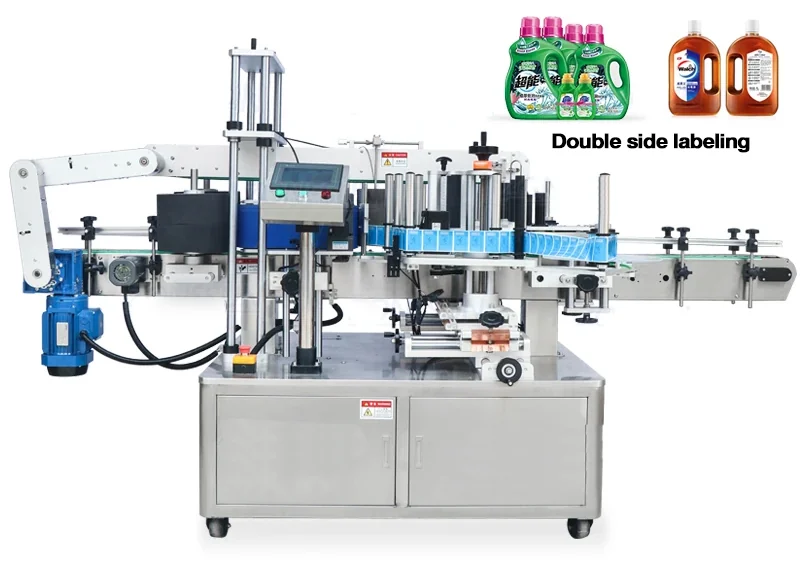
How do labelling-machine sensors detect products and labels?
A labelling machine normally uses separate sensing functions for the product, the label web and machine movement. Each sensor answers a different question, so reliable application depends on matching the sensing method to the real product and label.
The short answer
Product sensors detect that a pack has reached a defined point, label sensors detect the position of labels on the backing web, and encoders or machine feedback can measure movement. They are separate because a product can be present while the label web is not ready, and a label can be correctly indexed while the product is badly positioned.
Why are several sensing functions needed?
| Sensing function | Question it answers | Failure if it is assumed |
|---|---|---|
| Product detection | Has a product reached the trigger point? | A label may dispense with no pack or at the wrong position |
| Label detection | Where does one label end and the next begin? | The web may stop inconsistently or feed two labels |
| Motion reference | How far has the conveyor or web moved? | Timing can drift when line speed changes |
| Verification | Was the expected print or label result achieved? | A machine cycle may complete without a conforming product |
How is a label detected on the backing liner?
The selected method depends on the optical, electrical and physical difference between the label and liner. Conventional gap sensors may work well for opaque labels with a clear gap. Transparent films, metallic constructions, heavy printing or unusual liners may need a different sensing method or a registration feature.
Optical, ultrasonic and capacitive technologies are examples used in industrial label detection, but the technology name alone does not prove suitability. The finished converted roll should be taught and tested at the intended web speed, including the least distinct label area.
How is the product detected?
Photoelectric, through-beam, retro-reflective or other industrial sensing arrangements may be used depending on product material, colour, transparency, shape and background. A clear PET bottle, highly reflective pack, dark object or flexible pouch can each present a different detection challenge.
The sensor position must correspond to a repeatable product feature. If the trigger detects a cap, handle or moving pouch edge instead of the intended pack datum, label position can vary even though the sensor operates every cycle.
When is a motion reference needed?
A fixed time delay can be adequate only when product presentation and speed are sufficiently repeatable. Where conveyor speed changes, an encoder can let dispensing follow actual movement. It does not remove the need for controlled product spacing and it cannot compensate for product slip after detection.
The project should define which shaft or conveyor represents product movement, what happens when it stops, and how the system behaves if the encoder signal is lost.
Common buyer questions
Why are product and label sensors separate?
They monitor different parts of the process. The product sensor triggers an application opportunity; the label sensor indexes the label web. Separating them allows the controls to stop or alarm when one condition is present without the other.
Can transparent labels be detected?
Transparent labels can often be detected with a suitable sensing method, but label film, liner, adhesive, printing and gap all influence the result. A production roll should be tested before the sensor route is confirmed.
Can reflective or transparent products cause sensor errors?
They can. Reflections, background changes and light transmission can make a simple diffuse sensor unstable. The product sensor should be selected and positioned using the actual pack and background conditions.
Should sensor settings be stored in the machine recipe?
Where the sensor and control system support it, verified settings may be associated with a format recipe. The first products after a changeover still need confirmation because the physical sensor position, roll loading and product presentation can change.
Sensor test plan before acceptance
- Run the most transparent, reflective, dark and irregular products in the intended range.
- Use finished labels with the production liner, artwork, gap and roll winding.
- Test normal speed changes, start, stop, starvation and downstream blockage.
- Confirm sensor response after a roll change and product changeover.
- Introduce a missing label, web break or product gap and record the machine response.
- Check that faults identify the failed function rather than only showing a generic stop.
Continue the labelling-machine decision
Use the page that matches the next technical or buying question, then send the confirmed information with your enquiry.
Clear-label sensor guide
Plan testing for transparent label and liner combinations.
ControlsControls and line interlocks
Define the signal and recovery behaviour around each sensor.
EquipmentLabel applicators
Review product trigger and label-head integration.
AcceptancePlacement acceptance criteria
Turn sensor repeatability into an observable test.
Ask Lancing to review the real product and label
Share photographs, dimensions, production-condition samples, label-roll details and the intended line arrangement so the guidance can be checked for the actual application.