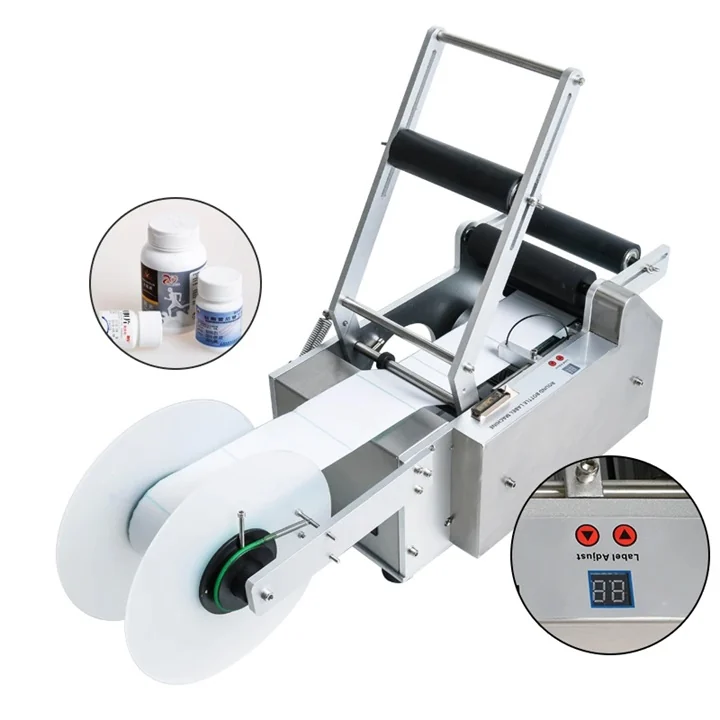
Where semi-automatic labellers work best
Semi-automatic labelling machines are suited to short runs, start-up production, contract packing trials and products that do not justify a full conveyor-fed system. The operator loads each product and the machine controls label dispensing and application.
- Lower investment than fully automatic systems
- Good for small batches and multiple SKUs
- Fast setup for round bottles and jars
- Useful for product trials and new launches
Limits to consider
Output depends on the operator and changeover discipline. Semi-automatic machines are not always suitable for unstable products, very high speeds or packs requiring multiple precisely aligned labels.
- Operator-dependent throughput
- Manual product loading and unloading
- Adjustment needed between container sizes
- Samples should be tested before purchase
Common questions
Are semi-automatic labellers accurate?
They can be accurate when the product is stable and loaded consistently. Accuracy depends on container quality, label roll quality and operator technique.
What products suit a semi-automatic wrap labeller?
Round bottles, jars and cylindrical containers are the most common applications.
Can a semi-automatic labeller be upgraded later?
Some projects start semi-automatically, then move to an automatic inline labeller when output increases.
Related machinery and guides
Use these pages to move from research into the correct machine range.
Need a labelling machine recommendation?
Send product photos, container dimensions, label size, label roll details and target output. Lancing UK can advise the correct labeller type before quotation.
Choose semi-automatic equipment when the machine must control placement
A label dispenser can reduce peeling time but leaves alignment, wipe-down and final presentation with the operator. A semi-automatic labeller becomes useful when the product can be loaded individually but the label position needs a repeatable mechanical reference.
- Round bottles benefit from controlled rotation while the label is applied.
- Flat products benefit from a fixture, stop or supported application surface.
- Front/back applications need the relationship between both labels controlled.
- Transparent or difficult labels need the intended sensor and production roll tested.
Compare the full decision in the label dispenser versus labelling machine guide, and use the self-adhesive labelling guide to identify the correct application method.