How to choose a self-adhesive labelling machine
A practical UK guide to pressure-sensitive labelling machinery, from label dispensers and semi-automatic systems to conveyor-fed automatic labellers.
What is a self-adhesive labelling machine?
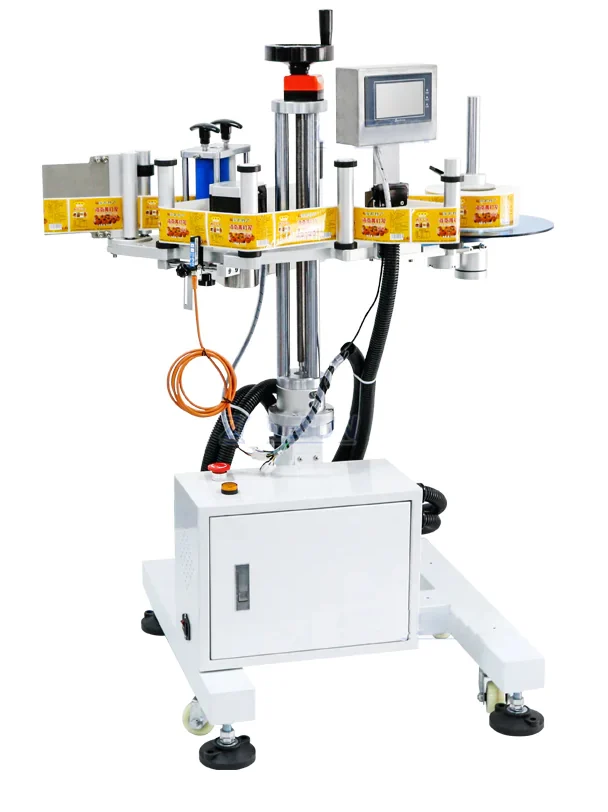
A self-adhesive labelling machine applies pressure-sensitive labels supplied on a release liner. The machine unwinds the roll, detects each label, separates it from the liner at a peel edge and presents it to the product. The correct machine route depends on the product shape, the label position, the way the pack is controlled and the level of automation required.
“Self-adhesive” and “pressure-sensitive” describe the same broad label technology. The label does not need wet glue or a shrink tunnel, but the adhesive, label material, liner, sensor and product surface still have to work as one system.
How the application process works
- Unwind: the label roll is held under controlled tension so the web feeds consistently.
- Registration: a label sensor detects the gap, mark or material change that identifies each label.
- Peel: the liner changes direction around a peel plate while the label continues towards the product.
- Product trigger: a product sensor or machine cycle starts label feed at the correct moment.
- Application: a wipe, tamp, blow, belt or wrap device transfers and presses the label onto the surface.
- Liner rewind: the spent backing is collected so it does not obstruct the machine or operator.
Every stage can affect placement. A label may be detected correctly but still skew if the product moves, the web tracks poorly or the wipe-down method does not suit the pack geometry.
Choose the machine route from the product and label position
| Application route | Typical product condition | Main specification risk |
|---|---|---|
| Wrap-around | Round bottles, jars, cans and tubs able to rotate consistently | Product control, skew and the meeting seam |
| Front and back | Flat, oval or shaped packs with two defined faces | Orientation, side control and alignment between labels |
| Top or side apply | Boxes, pouches, trays, cards and stable flat products | Product pitch, surface support and wipe direction |
| Top and bottom | Flat packs requiring labels on opposite faces | Transfer across the underside application point |
| Shaped or multi-panel | Square, hexagonal or irregular packs with several reference faces | Positive orientation and controlled presentation |
| Print and apply | Products, cases or pallets needing variable information | Data ownership, print quality, application and verification |
Start with the required label position rather than the machine photograph. The product range separates these application routes, while the buying guide connects them to automation level and line integration.
Label dispenser, semi-automatic or fully automatic?
A label dispenser only peels and presents a label for an operator to apply by hand. A semi-automatic labeller requires the operator to load or present the product, but the machine controls the application. A fully automatic system detects, handles and labels products on a conveyor with limited routine operator intervention.
- Use a dispenser when volumes are low and manual placement variability is acceptable.
- Use a semi-automatic labeller when the operator can load each product but repeatable placement is important.
- Use an automatic labeller when products already flow on a line, labour handling needs to reduce or consistent continuous presentation is required.
The label dispenser versus labelling machine guide provides a fuller decision matrix.
Specify the label roll before committing to production stock
Provide the individual label width and length, gap, liner width, core size, outside roll diameter, unwind direction, material, adhesive and whether the label is paper, film, metallic or transparent. The artwork orientation and leading edge must match the machine hand and application direction.
Transparent labels may require a different sensing method from opaque paper labels. Metallic materials, very thin films, dark liners and irregular gaps can also alter sensor choice. A production-quality roll is more useful for testing than artwork alone. Use the label roll specification guide and clear-label sensor guide when preparing samples.
Check the real pack surface and production environment
Self-adhesive labels need a compatible surface and representative application conditions. Moisture, oil, dust, release agents, low temperature, tight curvature, flexible walls and moulded seams can all affect adhesion or appearance. More wipe pressure cannot reliably compensate for an incompatible adhesive or a contaminated pack.
Trial containers should be supplied in the condition seen at the labelling station. Filled weight, temperature and rigidity can change how the pack behaves under guides, belts and wipe-down pressure. The label adhesion guide explains how to build a practical trial matrix.
Define product handling and line integration
An applicator head alone does not space, orient or stabilise products. A complete automatic machine may need infeed control, side guides, top hold-down, wrap belts, starwheels, transfer conveyors, guarding, reject handling and signals to surrounding equipment.
State the conveyor direction and height, normal and peak production rate, product pitch, available footprint, stop/start behaviour and any filler, capper, coder, inspection system or packing equipment connected to the labelling station. A line-layout drawing and short video of the current process can expose handling constraints before quotation.
Build a representative sample and acceptance plan
- Smallest and largest products, including the least stable format.
- Products filled or weighted to represent production.
- Production-quality label rolls for each material or construction.
- Marked drawings showing the required label position and reference edge.
- Normal operating rate, changeover range and stop/restart conditions.
- Agreed visual, placement, coding and verification checks.
Acceptance should confirm the complete application rather than only whether a label was dispensed. Check placement, skew, wrinkles, bubbles, edge lift, label presence, print readability where relevant, changeover repeatability and controlled recovery after a stop.
Questions buyers ask about self-adhesive labelling machines
Is self-adhesive labelling the same as pressure-sensitive labelling?
Yes. Both terms describe a label with adhesive already applied, carried on a release liner and transferred to the product by pressure. The preferred wording varies between suppliers and buyers.
Can one self-adhesive labeller handle several products?
Often, but the practical range depends on product geometry, stability, label position, label dimensions and changeover method. Large differences may require tooling, recipes, repositioning or a different machine route.
Can the same machine apply clear labels?
Potentially, provided the label material, liner and gap can be detected reliably and the application method suits the transparent film. Clear labels should be tested on the intended sensor and production roll.
Does the labelling machine determine which adhesive is needed?
No. Adhesive selection belongs with the label converter and pack owner, using the real surface, application temperature and service conditions. The labeller must then transfer and wipe down that chosen construction consistently.
Continue the specification
Label applicators and retrofit heads
Compare standalone heads and complete conveyor-mounted systems.
AutomationLabel dispenser or labelling machine?
Choose the lowest level of automation that still controls the required result.
DefinitionWhat is pressure-sensitive labelling?
Understand the terminology, label construction and application sequence.
Send the pack and label together
Provide representative products, production labels, the required position and the current line arrangement so Lancing can identify the correct self-adhesive labelling route.