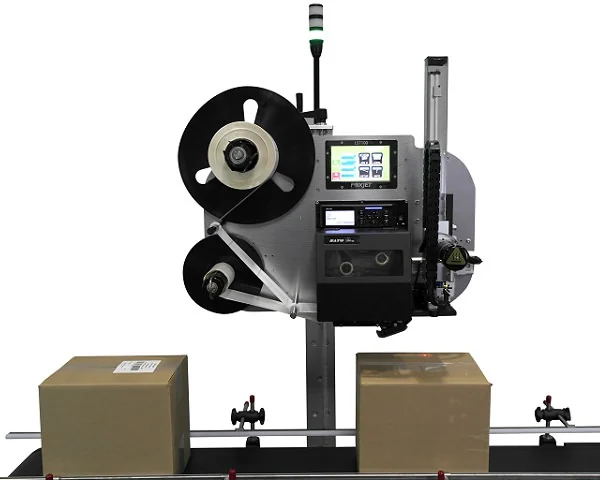
When print and apply is required
Use print and apply when variable information has to be printed at the point of production. Typical data includes batch, date, barcode, weight, address, dispatch or pallet information.
Choosing the applicator method
The applicator method depends on whether the product stops, moves continuously, has an uneven surface or needs one, two or multiple labels.
Data and line integration
Printer language, database connection, barcode verification and reject strategy should be reviewed early so the labeller works with the wider production system.
Need a machine recommendation?
Send product and label details to Lancing UK and the most suitable labelling route can be checked before quotation.
Specify the variable-data chain, not only the applicator stroke
A print-and-apply project combines data selection, print technology, label handling, product detection, application method, verification and failed-product control. The scope should show who owns each stage and what evidence proves a correct result.
| Application method | Typical decision factor | Evidence to prove |
|---|---|---|
| Tamp | Defined product position and contact application | Stroke, pad contact, cycle and product tolerance |
| Blow or tamp-blow | Reduced contact or variable surface | Label flight, product distance and environmental stability |
| Wipe-on | Moving product with a suitable flat or consistent surface | Speed matching, wipe pressure and edge control |
| Corner wrap | One label across two faces of a case | Corner geometry, label length and final wipe-down |
| Belt transfer | Continuous product movement or lightweight packs | Transfer speed, vacuum control and product support |
Define the data before the machine interface
List every variable field, where it comes from, how the job is selected, how a message is acknowledged and what happens after a network or host fault. Identify the product or logistics unit that the data belongs to and how that relationship is maintained through the conveyor.
Separate print, read and verification requirements
A reader can confirm that it decoded a symbol; formal verification measures symbol quality to an applicable standard. State which is required and define the failure response. The barcode verification guide provides a complete test framework.
Provide the complete application envelope
- Smallest and largest products, cases or pallets.
- Application face, distance and orientation.
- Label size, material, print method and consumables.
- Normal and peak line rate, product pitch and available stop time.
- Data source, interface, job-change method and retained records.
- Reader or verifier, reject method and confirmation.
Use representative finished packs, not only flat test boards. Corrugated surfaces, stretch wrap, seams, corners and pallet overhang can change the final barcode and label appearance.
When should variable data be printed on a label rather than directly on the pack?
Print and apply is appropriate when the variable information needs a defined label area, a scannable logistics symbol, a large data field, a standardised position or separation from the pack material. Direct coding can be simpler when a short code can be printed reliably onto the pack surface without a label.
| Decision factor | Print and apply | Direct marking or coding |
|---|---|---|
| Data area | Supports a larger formatted label with text, graphics and barcodes | Usually suited to a smaller code or mark |
| Surface dependence | The label provides a controlled printable surface, but adhesion must suit the pack | Print quality depends directly on the pack material, colour, finish and distance |
| Variable logistics data | Well suited to shipping, case and pallet labels generated on demand | May suit simple batch or date information where a label is unnecessary |
| Verification | Print, application and barcode reading can be checked as separate stages | Mark presence and readability are checked directly on the pack |
Choose by the information requirement and pack surface, not by assuming one method is universally better. Where both are used, define which system owns each data field and how duplicate, missing or stale information is prevented.