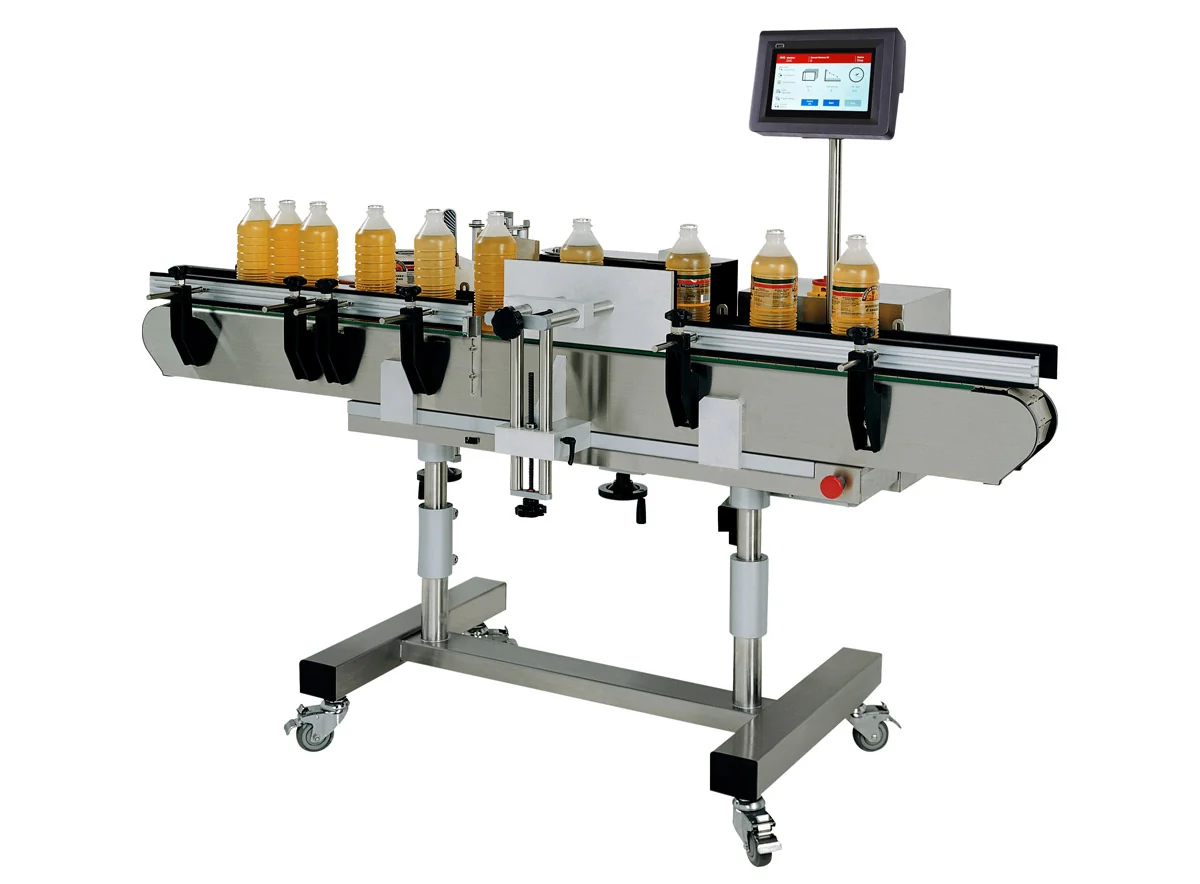
When to use wrap-around labelling
Wrap-around machines are used when the label follows the curved surface of a cylindrical bottle or jar. The machine has to rotate or control the bottle while the label is dispensed.
Common issues to avoid
Tapered bottles, soft containers, unstable bases and very long labels can affect application. Samples should be checked before the machine is finalised.
Semi-automatic or automatic
Semi-automatic machines suit short runs and operator-controlled batches. Automatic machines suit continuous production and integration with fillers, cappers and conveyors.
Need a machine recommendation?
Send product and label details to Lancing UK and the most suitable labelling route can be checked before quotation.
Prove rotation, label geometry and the meeting seam
Round-bottle labelling is reliable when the container rotates about a stable axis while the label is dispensed at a matched rate and wiped down without the product slipping, leaning or changing diameter across the label area.
| Route | Best suited to | Key proof |
|---|---|---|
| Semi-automatic wrap-around | Short runs with operator loading and a stable cylindrical pack | Repeatable loading, label start position and operator cycle |
| Compact automatic | Growing production needing conveyor feed in a smaller footprint | Automatic spacing, product control and changeover range |
| Inline automatic wrap-around | Continuous lines with repeatable product flow | Pitch, rotation, seam, restarts and connected-machine behaviour |
| Front and back | Oval, flat or shaped bottles with two presentation panels | Orientation and the relationship between both labels |
Container details that change the result
Measure the diameter at the top and bottom of the label panel, not only the nominal bottle diameter. Record taper, ovality, moulding seams, base stability, filled weight, cap or pump, and whether the bottle can rotate without rubbing a handle or decoration. A very slight taper may still create visible skew on a long label.
Label roll details to confirm before printing
Supply label height and length, gap, liner width, core, outside roll diameter, unwind direction, material, adhesive and whether the label is transparent or metallic. Confirm which artwork edge leads into the applicator. A production roll is more useful than artwork because it exposes die-cutting, liner, curl and sensor behaviour.
Acceptance checks for a wrap-around label
- Placement from a defined bottle datum.
- Skew from leading to trailing edge.
- Meeting seam or overlap relationship.
- Wrinkles, bubbles, lifting edges and wipe-down marks.
- Repeatability after a roll change and format change.
- Behaviour after a controlled stop and restart.
Where the pack is tapered or irregular, use the tapered-container guide. Where adhesion changes with chilled or damp products, use the surface and environment guide.