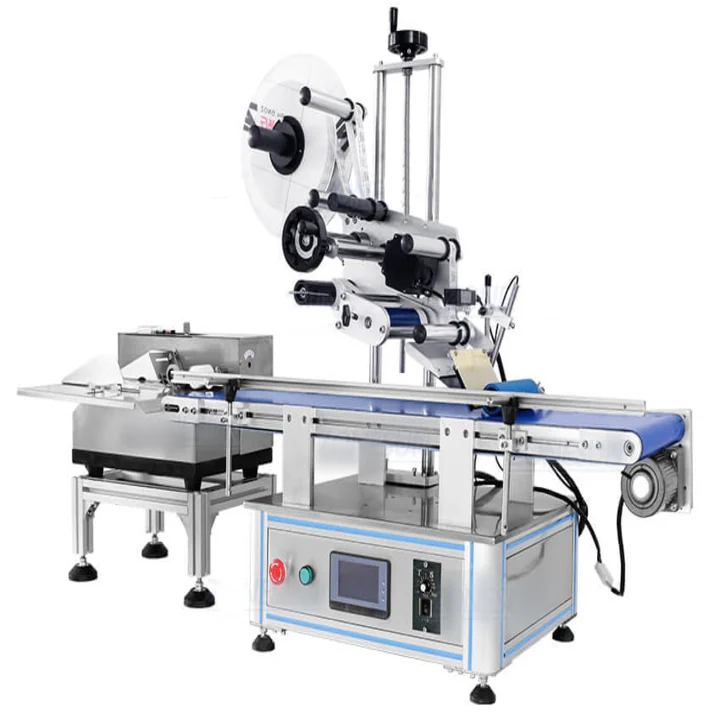
Applications for flat product labelling
Flat surface labellers apply labels to pouches, cartons, boxes, bags, trays, lids, cards and other products with a stable top or side face. Product presentation and conveyor support are critical because flexible or uneven packs can move during application.
- Pouches and sachets
- Boxes, cartons and cards
- Lids, trays and flat packs
- Top labels, side labels and tamper labels
Handling and repeatability
For a clean result the product must be guided under the label head with controlled height and speed. Lightweight products may need belts, guides or a top hold-down to keep them stable.
- Check product thickness and flatness
- Confirm label position tolerance
- Consider wipe-down rollers or brushes
- Plan coding before or after labelling
Common questions
Can flat labellers label pouches?
Yes, but pouch thickness, fill level and surface flatness need to be checked.
Can one machine label boxes and bags?
Possibly, if the size range and handling method are compatible. Mixed formats should be reviewed before quotation.
Do flat labellers support date coding?
They can often be integrated with coding before or after the label application point.
Related machinery and guides
Use these pages to move from research into the correct machine range.
Need a labelling machine recommendation?
Send product photos, container dimensions, label size, label roll details and target output. Lancing UK can advise the correct labeller type before quotation.
Identify what makes the pack stable under the label head
A flat label panel does not necessarily mean the whole product travels as a rigid flat object. Provide samples showing folds, contents, raised edges or changes in thickness. Mark the surface that will rest on the conveyor and the surface that receives the label.
If one machine is intended to label cards, cartons and flexible packs, list them as separate handling cases. Ask which presentation method and adjustments apply to each. Include the approach, label application and exit in the trial rather than approving a manually positioned sample alone.
- Repeatable reference
- Define the edge or feature from which label position is measured and show any variation in that reference across the pack range.
- Production supply
- Describe how items are separated and fed, and clarify whether that task is included in the proposed equipment.
What should a flat-pack labelling demonstration include?
Use representative packs, production label rolls and the planned feeding method. Record label placement and accepted output through the complete sequence, including refilling or changing the pack supply where that is part of normal operation.