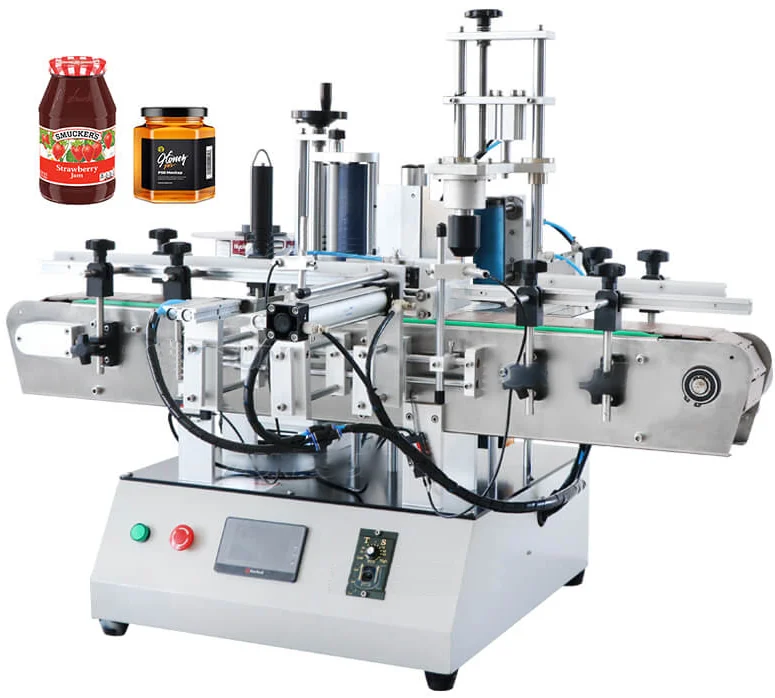
How do pack features such as handles, seams and recesses affect labelling?
Handles, mould seams, shoulders, recesses and closures can interrupt label contact, change the preferred orientation and restrict where guides, belts or rollers can touch the pack. They must be treated as part of the handling specification.
The short answer
A pack feature matters whenever it changes contact, orientation or the available label panel. A handle can prevent free rotation, a seam can show through a clear label, a recess can stop the wipe-down device reaching the full surface, and a shoulder or cap can collide with guides.
How common pack features change the application
| Pack feature | Possible effect | What to confirm |
|---|---|---|
| Handle or trigger | Creates a preferred orientation and can obstruct belts or rollers | Orientation method and clear handling path |
| Mould seam or weld line | Changes surface height and may show through the label | Label position, material flexibility and approved appearance |
| Recessed panel | Reduces access for wipe-down and can trap air at edges | Applicator geometry, label size and contact method |
| Shoulder or taper | Changes circumference and can drive label skew | Label shape, position and container control |
| Cap, pump or overhang | Can interfere with top hold or side guides | Guide clearance and product stability |
| Flexible wall | Moves under pressure and changes the panel shape | Filled condition, support and wipe-down force |
When does the product need orientation?
Orientation is needed when the label must align with a specific feature or avoid a feature that is not rotationally symmetrical. The method may use the container shape, a moulded lug, a mark, the handle or another repeatable reference. The selected reference has to be detectable and mechanically stable at the intended rate.
A free-spinning wrap-around system is not automatically suitable just because part of the container is round. Where the handle or panel defines the result, positive orientation or a front-and-back route may be more appropriate.
Design the label around the real panel
Measure the usable label panel rather than the overall container. Allow for edge radii, taper, seams, embossing and any area that the applicator cannot press evenly. A label that crosses several changing surfaces may wrinkle or lift even when the placement point is correct.
Where artwork can still change, review the die line and label position before ordering production rolls. Reducing label size, changing shape or moving the label away from a feature can be more reliable than trying to force the machine to correct an unsuitable panel.
What should a shaped-pack trial prove?
- The product reaches the labelling point in the intended orientation.
- Guides and stabilisers do not damage handles, caps, pumps or flexible walls.
- The label clears seams, recesses and radii as intended.
- Wipe-down contact reaches the full required area without excessive pressure.
- The most difficult and least rigid product remains stable at the intended condition.
- Placement is repeatable after a normal changeover and restart.
- The approved appearance is recorded on the real container and label material.
Common buyer questions
Can a label cross a mould seam?
It may be possible, but the seam height and label material can affect contact and appearance. Clear films can make the seam especially visible. Test the finished label on production containers and define the accepted result.
Can a label be applied inside a recessed panel?
A recess may be labelable if the applicator can present and wipe the label into the panel without bridging the edges. Depth, corner radius, panel size and product rigidity determine the practical route.
How do handles affect orientation?
A handle creates a fixed relationship between the product and the desired label face. The machine must detect or mechanically control that relationship before application, and the handling path must avoid collision with the handle.
Why does filled weight matter on a shaped pack?
Filled weight and product distribution affect stability, centre of gravity and wall rigidity. A container that stands and guides correctly when full may behave differently when empty, or vice versa.
Information to provide for a shaped-container enquiry
- Dimensioned photographs or drawings showing handles, seams, recesses, shoulders and closures.
- The intended label panel and relationship to each feature.
- Filled weight, centre of gravity, wall flexibility and base stability.
- Smallest and largest products and any feature variation between moulds or suppliers.
- Finished label material, size, gap, roll direction and artwork.
- Orientation requirement and acceptable placement reference.
- Production-condition samples for trial and approval.
Continue the labelling-machine decision
Use the page that matches the next technical or buying question, then send the confirmed information with your enquiry.
Hexagonal and shaped-container labelling
Review positive handling for multi-panel products.
Two labelsFront and back labelling
Compare controlled panel presentation for flat and oval faces.
SelectionContainer shape and label position
Map product geometry to the likely machine route.
SurfaceSurface and adhesion conditions
Assess the label contact condition as well as the geometry.
Ask Lancing to review the real product and label
Share photographs, dimensions, production-condition samples, label-roll details and the intended line arrangement so the guidance can be checked for the actual application.