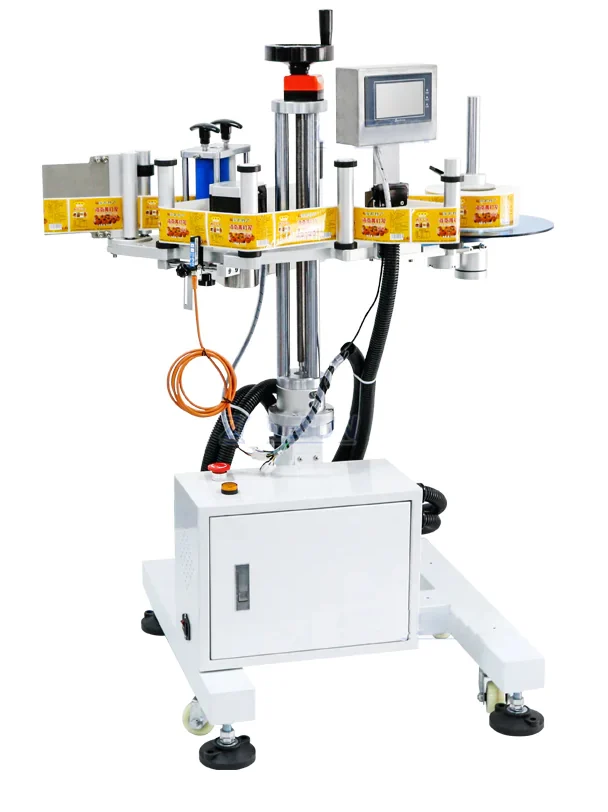
What is pressure-sensitive labelling?
Pressure-sensitive labelling applies a self-adhesive label from a release liner to a product without a wet-glue application stage. The label is dispensed at a peel edge, detected and placed using a handling method matched to the pack.
Pressure-sensitive labelling in one answer
Pressure-sensitive labelling is the automatic or semi-automatic application of a pre-gummed label that bonds when controlled pressure brings it into contact with the pack. The label travels on a release liner, passes a sensor and is separated at a peel plate or dispensing edge. The product must then be presented so the label lands in the correct position and is wiped, rolled or pressed down consistently.
How does pressure-sensitive labelling work?
A reel of converted labels is unwound through a controlled web path. A label sensor identifies the gap or registration feature, while a product sensor or machine cycle determines when dispensing should begin. The liner changes direction over the peel edge, causing the stiffer label to continue towards the product. The used liner is then rewound.
Dispensing is only part of the process. The final result depends on the way the pack is transported, spaced, orientated and stabilised. A round bottle may be rotated while the label wraps around the circumference. A flat or oval bottle may pass between side guides and separate front and rear heads. A carton or pouch may be presented beneath a top applicator.
Which machine routes use pressure-sensitive labels?
| Pack and label task | Typical handling responsibility | Questions to confirm |
|---|---|---|
| Round bottle or jar | Controlled rotation and wrap-down | Taper, rigidity, circumference, seam or overlap |
| Flat, oval or rectangular container | Orientation, side guiding and one or two label heads | Panel datum, front-to-back relationship, product twist |
| Box, card, tray or pouch | Flat presentation beneath or beside an applicator | Thickness, flexibility, feed consistency and support |
| Case or pallet with variable data | Print engine, product tracking and application device | Data source, verification, queue recovery and label face |
These are process routes rather than guaranteed machine specifications. The actual equipment must be checked against the intended products, label rolls and line conditions.
How does pressure-sensitive labelling compare with other methods?
| Method | Where it is useful | Main trade-off to assess |
|---|---|---|
| Pressure-sensitive label | Flexible decoration or information on many pack shapes | Requires compatible label stock, accurate presentation and liner disposal |
| Shrink sleeve | Large decoration area, full-body coverage or neck-band formats | Adds sleeve handling and a controlled shrink process |
| Print and apply | Variable data created close to the point of application | Adds data ownership, print quality and product-to-label tracking |
| Direct coding | Small variable marks without a separate applied label | Does not provide the same decoration area or removable label format |
Common buyer questions
Is self-adhesive labelling the same as pressure-sensitive labelling?
In packaging machinery, the terms are commonly used for the same general process: a label with a pre-applied adhesive is removed from a release liner and pressed onto the pack. The exact label construction and adhesive still need to be matched to the product surface and operating conditions.
Does pressure-sensitive labelling need heat?
The basic application process does not require a heat-shrink tunnel. Some label materials, adhesives or production environments may still have temperature requirements, so the pack and label stock should be assessed in their real application condition.
Can clear labels be pressure-sensitive?
Yes. Clear film labels can use pressure-sensitive adhesive, but transparent label and liner combinations may need a sensing method proven against the finished roll. The final appearance also depends on surface cleanliness, bubbles, wipe-down and the colour or texture behind the label.
Can pressure-sensitive labels carry variable data?
They can be pre-printed and coded inline, or printed immediately before application in a print-and-apply system. The correct route depends on how much data changes, where it originates and whether the print and applied label must be verified.
Information to provide before a pressure-sensitive labelling enquiry
- Product shape, material, smallest and largest dimensions, filled condition and stability.
- Required label position, number of labels and relationship to handles, seams, panels or existing print.
- Label size, material, liner, gap, core, outside roll diameter and unwind direction.
- Normal output, batch size, changeover frequency and surrounding conveyor or machinery.
- Coding, inspection, reject, guarding, cleaning and environment requirements.
- Representative products and a finished production label roll where possible.
Continue the labelling-machine decision
Use the page that matches the next technical or buying question, then send the confirmed information with your enquiry.
Label applicators and retrofit heads
Compare standalone heads with complete product-handling systems.
Label rollRoll and core specification
Record the roll details needed for a repeatable machine set-up.
ComparisonSleeve or pressure-sensitive?
Compare the process responsibility and pack requirements.
SelectorLabelling machine product range
Move from the process definition to the relevant machine family.
Ask Lancing to review the real product and label
Share photographs, dimensions, production-condition samples, label-roll details and the intended line arrangement so the guidance can be checked for the actual application.